
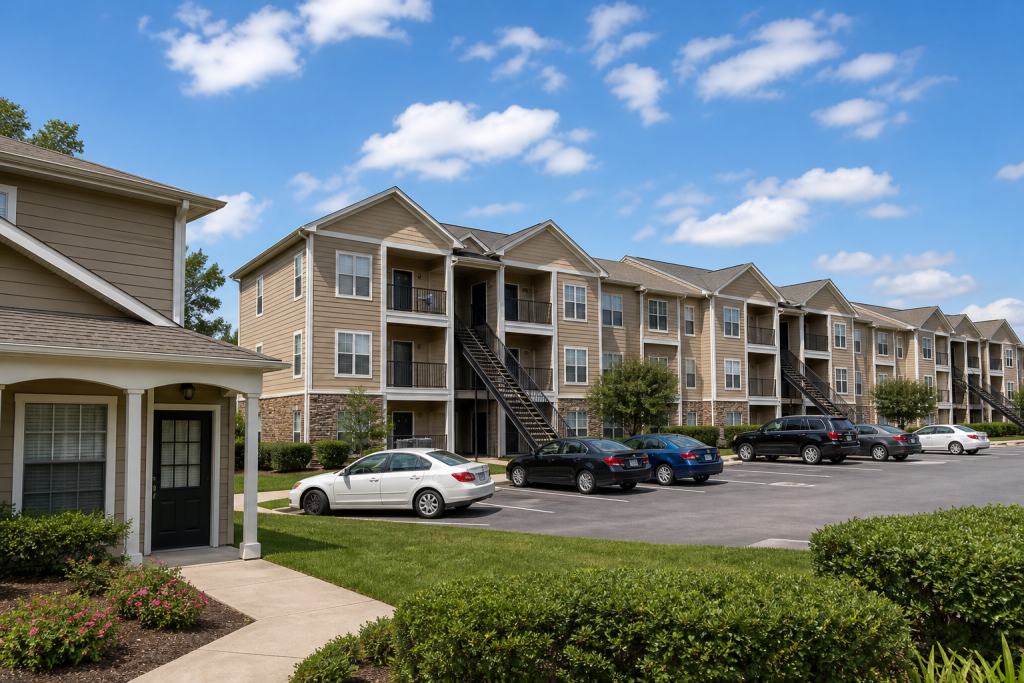
Multifamily insurance is the commercial property and liability program that sits on an apartment community: the buildings, the income, and the owner’s exposure to tenants and visitors. In a hard market, carriers are non-renewing older frame product, raising water and wind deductibles, and moving habitational risks into surplus lines. Owners who shop only on premium find out at claim time that the policy no longer matches the asset.
This is for apartment owners, operators, and investment groups—not HOA boards and not single-family landlords. If you want the current program read before the next renewal, contact Aegis.
Aegis Group is an independent insurance brokerage. We work for the owner, not the carrier.
What multifamily insurance is (and is not)
Multifamily insurance is a commercial habitational placement. It is built for income-producing buildings with multiple rental units: garden-style, mid-rise, and mixed portfolios. It is not:
- A homeowners policy or a landlord DP-3 on a single rental house
- An HOA master policy for condos or townhomes the association owns
- Renters insurance (that is the tenant’s contents and liability)
The owner’s policy has to survive a fire, a stack failure, a hailstorm, and a serious injury in a common area—and still leave net operating income standing. That is a different job than covering one house.
Aegis’s real estate insurance work starts there: the policy, the exclusions, the endorsements, and the statement of values, before anyone talks about a cheaper number.
Why carriers tightened on apartments
Habitational losses—especially water—have been frequent and expensive. Rebuild costs moved faster than many statements of values. Older wood-frame product, prior claims, and CAT-exposed locations no longer fit admitted appetite the way they did a few cycles ago.
What owners are seeing:
- Non-renewal on aging frame and garden-style communities
- Percentage deductibles for wind and hail
- Separate, higher deductibles or sublimits for water
- Roof-age, plumbing, and claims requirements before a quote
- Movement from admitted paper into excess and surplus (E&S)
A lower premium with a $50,000 or $100,000 water deductible is not a win if one failed supply line wipes out several units and a month of rents. The deductible is an unbudgeted capex event.
Aegis’s multifamily book nearly doubled in the hard market because owners needed a broker who could still place the risk. That is the market this article is written for.
What belongs on the policy
1. Property limits that can actually rebuild
Ask, in writing:
- Replacement cost or actual cash value?
- Does the statement of values match current rebuild cost, not last year’s schedule?
- Are clubhouses, garages, carports, and amenities on the form?
- Is ordinance or law included on older buildings that cannot be repaired to the old code?
Underinsurance is the quiet failure. After a fire, “we had coverage” is not the same as “we can put the community back.”
2. Water that matches how apartments actually fail
Water is the claim that hits multifamily first: supply lines, drain backup, slab leaks, roofs, and unit-to-unit seepage. Confirm:
- Which water perils are covered vs. excluded
- Whether sewer and drain backup is on the form
- Whether the water deductible is separate from all-other-perils
- How tenant-caused damage is treated vs. building systems the owner maintains
If the answer is “we’ll see at claim time,” the program is already thin.
3. Wind, hail, and named-storm deductibles you can fund
Convert every percentage deductible to dollars per building and per occurrence before you bind. Compare that number to reserves and to what a lender will tolerate. A 2% wind/hail deductible on a $20 million schedule is not a footnote.
4. Loss of rents
Loss of rents (business interruption for the building) is how you keep debt service and operations going while units are uninhabitable. Check the waiting period, the indemnity period, and whether the limit matches actual rental income—not a round number from three renewals ago.
5. Liability and umbrella that match amenities and traffic
Pools, playgrounds, sidewalks, parking lots, and on-site staff drive frequency. A limit that looked fine on a 24-unit walk-up is not fine on a 250-unit community with a pool. Umbrella is how a serious injury stays a claim instead of an equity event.
6. Equipment breakdown, flood, and the other “we assumed it was in there”
Boilers, HVAC, and elevators often sit outside the property form. Flood and earthquake almost always do. If the community is in a flood zone or on a slab in a high-water table, say so in the submission. Do not find out after the loss.
Portfolio placements vs. one-off buildings
Owners with more than one community should not treat each property as a separate shopping trip with a different form and a different deductible philosophy. A schedule can simplify administration. It can also hide a badly valued location inside a large TIV.
Before you bind a portfolio:
- Every location’s construction, occupancy, and claims history should be accurate
- Deductibles should be ones you can actually pay at the worst location, not the average one
- Vacancy, rehab, and lease-up assets need to be disclosed
Lenders will ask. So will the next buyer’s diligence.
How to shop when the market is tight
Do not start with “get three quotes.” Start with a file a carrier can underwrite.
- Current policy, including every endorsement
- Statement of values and a current rebuild estimate
- Five-year loss runs
- Roof ages, plumbing type, updates, occupancy, and amenities
- What you will not trade: water, loss of rents, replacement cost, deductible ceiling
Then market it. An independent broker can tell you when the admitted market is gone and what E&S actually changes on the form. That is different from an agent who can only offer one company’s habitational product.
Aegis has placed more than $4 billion in real estate insured value across 40+ states, with offices in Wichita and Dallas–Fort Worth. The process is the same: find the holes first, then place coverage. Proof points on scale and history are on About Aegis.
What to do before the next renewal
- Start 90–120 days out, not 30
- Read a non-renewal or change-in-terms letter the day it arrives
- Require tenant renters insurance and keep it enforced
- Do not bind a renewal you have not compared, line by line, to last year’s form
If the only option on the table is surplus lines and a deductible you cannot explain to a lender, get a second reading before you sign.
Request a review or call 316-779-2920.
FAQs
What is multifamily insurance?
Multifamily insurance is commercial coverage for apartment buildings and similar rental communities. It typically includes property, liability, loss of rents, and related lines. It is not renters insurance and not an HOA condo master policy.
Is multifamily insurance the same as apartment building insurance?
They overlap. “Multifamily insurance” is the portfolio / owner language. “Apartment building insurance” is often the same placement described by the asset. Both are commercial habitational, not personal lines.
Why did our multifamily insurance premium jump?
Hard-market pricing, water and wind losses, construction inflation, building age, and claims history. A cheaper premium with a much larger deductible is often a shift of risk back onto the owner.
Does the owner’s policy cover tenant belongings?
No. Tenants need renters insurance. The owner’s policy is for the building, the owner’s liability, and (if purchased) loss of rents.
Can we still get coverage after a non-renewal?
Often yes, sometimes only in surplus lines and with different deductibles and conditions. Do not wait until expiration to start.
Does Aegis write HOA and condo the same way as apartments?
No. Apartments are owner-held rental product. Condos and HOAs need a master policy and a different program (including Aegis Condo Protects for associations). Do not copy an apartment form onto an HOA.