
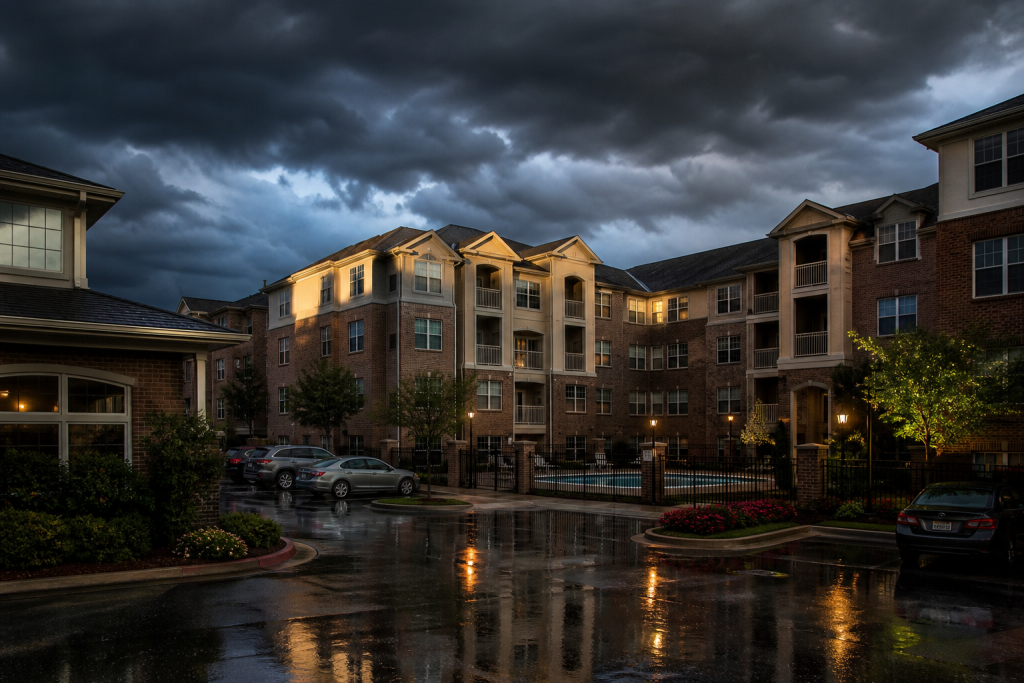
HOA insurance is no longer a once-a-year renewal you can rubber-stamp. In a hard market, carriers are non-renewing associations, raising deductibles, cutting water and wind coverage, and pushing older condominium buildings into surplus lines. Boards that treat the master policy as a commodity are the ones sending special assessments after the claim.
This guide is for HOA and condominium association boards, community managers, and board presidents who need to know what belongs on the master policy, where the gaps usually hide, and how to shop coverage when the market is working against you.
Aegis Group is an independent insurance brokerage. We represent the association, not the carrier. If you want the current policy reviewed before the next renewal, contact Aegis or call 316-779-2920.
What HOA insurance actually covers
HOA insurance is the association’s master policy. It protects the common property the board is responsible for: buildings, common areas, and the association’s liability. It is not the same as a unit owner’s HO-6 policy, and it is not the same as apartment building insurance for a rental community.
A typical HOA insurance program has several parts:
- Property on buildings, common elements, and (depending on the form) interiors down to a defined point
- General liability for injuries and property damage in common areas
- Directors and officers (D&O) for claims against the board
- Fidelity / crime for theft or mishandling of association funds
- Umbrella above the primary liability limits
The governing documents decide how far the master policy reaches into each unit. That is the first thing a board should confirm in writing: bare walls, original specifications, or all-in. If the declaration says one thing and the policy says another, a water loss will turn into a fight between the association, the unit owner, and both carriers.
Why the HOA market got hard
Carriers did not tighten HOA insurance because boards stopped caring. They tightened it because habitational claims—especially water—have been expensive, frequent, and slow to improve.
What boards are seeing now:
- Non-renewal letters on aging frame or mid-rise condominiums
- Percentage deductibles for wind and hail instead of a flat dollar amount
- Higher water-damage deductibles, or sublimits that do not match a real plumbing failure
- Requirements for roof age, plumbing updates, and reserve studies before the carrier will quote
- Movement from admitted markets into excess and surplus (E&S) when the building does not fit the box
A cheaper premium that arrives with a $50,000 or $100,000 deductible is not cheaper if the association cannot pay it. The deductible is an unfunded special assessment waiting for a storm or a failed stack.
What boards need on the master policy
1. The right property form, not just a limit
Ask, in writing:
- Is the building insured to replacement cost, or actual cash value?
- Does the statement of values match current rebuild cost, not last year’s appraisal?
- Is ordinance or law included for older buildings that cannot be repaired to the old code?
- Are roofs, boilers, elevators, and clubhouse amenities actually on the form?
Underinsured buildings are common. After a fire or major water loss, “we had a policy” is not the same as “we can rebuild.”
2. Water damage that matches how the building actually fails
Water is the claim that breaks HOA budgets: supply-line failures, drain backups, failed slabs, roof leaks, and unit-to-unit seepage. Boards should know:
- What water perils are covered vs. excluded
- Whether backup of sewers and drains is included
- Whether the water deductible is separate from the all-other-perils deductible
- Who pays for the unit interior vs. the common stack, based on the declaration and the policy
If the answer is “we’ll sort it out at claim time,” the board is already behind.
3. Wind, hail, and named-storm deductibles the reserves can survive
A 1% or 2% wind/hail deductible on a $12 million building is not a rounding error. Before you bind:
- Convert the percentage to dollars
- Compare it to reserves and to the association’s ability to assess
- Confirm whether the deductible applies per building, per occurrence, or per location
4. Directors and officers coverage for the people in the room
HOA boards get sued by owners over assessments, collections, vendor contracts, election procedures, and claim decisions. Property insurance does not cover that. HOA D&O does.
Look for:
- Coverage for the board, committee members, and the community manager if the contract requires it
- Defense costs that do not instantly erode the limit
- What is excluded (fraud, improper profit, and some employment claims)
5. Fidelity and crime
Someone on or around the board will have access to assessments, reserve accounts, and vendor payments. Fidelity coverage is inexpensive relative to the loss. Many governing documents and lenders require it. Confirm the limit against actual balances, not a leftover figure from five renewals ago.
6. Liability and umbrella that reflect amenities, not just unit count
Pools, playgrounds, sidewalks, parking, clubhouses, and sidewalks in freeze-thaw climates drive liability. A limit that looked fine on a 24-unit association with no amenities is not fine on a 200-unit community with a pool. Umbrella coverage is how you keep a serious injury from becoming an association-ending assessment.
The gaps that show up when you actually read the policy
Aegis reviews HOA and condominium programs the same way we review other habitational business: exclusions, endorsements, and statements of values first. Coverage and protection are not the same thing.
The issues we see most often:
- Master policy and CC&Rs that do not match on interior coverage
- Replacement-cost limits that have not kept up with construction inflation
- Water, roof, or cosmetic-damage exclusions the board never voted on with eyes open
- D&O written on a form that does not fit volunteer boards
- No ordinance or law on a 1970s or 1980s building
- Deductibles the reserve study never contemplated
- Unit owners who think the HOA policy covers their contents, betterments, and loss of use (it usually does not)
Lenders and buyers will ask about the master policy at resale. A thin program does not only hurt after a claim. It shows up in underwriting for mortgages and in owner questions at closing.
How to shop HOA insurance in a hard market
Do not start with “get three quotes.” Start with a file the market can underwrite.
Before you go to market:
- Current policy, including every endorsement
- Declaration / CC&Rs section on insurance
- Statement of values and a current rebuild estimate
- Five-year claims history
- Roof ages, plumbing type, updates, and any reserve study
- Occupancy mix (owner-occupied vs. rentals), if it affects the form
- Board’s position on deductible tolerance vs. premium
Then decide what you will not trade away. In this market, the lowest premium often means a non-admitted form, a larger water deductible, or a shorter notice period on non-renewal.
An independent broker can market the association to more than one carrier and tell you when the admitted market is gone. That is different from an agent who can only offer one company’s HOA product.
Aegis Condo Protects
Aegis built Aegis Condo Protects LLC (ACP LLC) for the condominium and homeowners association market because generic placements were leaving boards with pricing and coverage that did not match the risk. It is a specialist program, not a personal condo policy and not a one-size commercial package.
We still begin with discovery: what the current master policy actually does, where it conflicts with the governing documents, and what a claim would cost the association after the deductible. Then we place coverage. Aegis works for the board.
The firm has placed more than $4 billion in real estate insured value across 40+ states, with offices in Wichita and the Dallas–Fort Worth area.
What boards should do before the next renewal
- Put the renewal on the calendar 90–120 days out, not 30
- Read the non-renewal or change-in-terms letter the day it arrives
- Have counsel or the manager confirm the insurance requirements in the CC&Rs
- Require unit owners to carry HO-6 and to understand the association deductible
- Do not bind a renewal you have not compared, line by line, to last year’s form
If the association has already been non-renewed, or the only option on the table is a surplus-lines quote the board does not understand, that is the moment to get a second reading—not after the loss.
Request a review or call 316-779-2920. For related real estate work, see Aegis real estate insurance.
FAQs
What is HOA insurance?
HOA insurance is the association’s master policy. It covers common property, association liability, and usually board D&O and fidelity. It does not replace a unit owner’s HO-6 policy.
Does HOA insurance cover unit interiors?
Only to the point the governing documents and the policy form require. Some associations are insured to the bare walls. Others cover original specifications or more. Boards should not assume interiors are included.
Why did our HOA insurance premium jump?
Hard-market pricing, water and wind losses in the habitational book, building age, claims history, and higher rebuild costs. A lower premium with a much higher deductible is often a shift in risk back onto the association, not a true savings.
What is the difference between HOA insurance and condo insurance?
“Condo insurance” usually means the unit owner’s HO-6. HOA insurance is the master policy for the association. Both are needed. They are not substitutes.
Do HOA board members need D&O insurance?
Yes. Property coverage does not protect directors and officers from claims about how the board governed. Most associations should carry D&O designed for community associations.
Can an HOA get coverage after a non-renewal?
Often yes, but the options may be surplus lines, higher deductibles, or more conditions. The association should not wait until the expiration date to start that process.